

How much should I spend on marketing?
This is one of the questions I get asked most often.
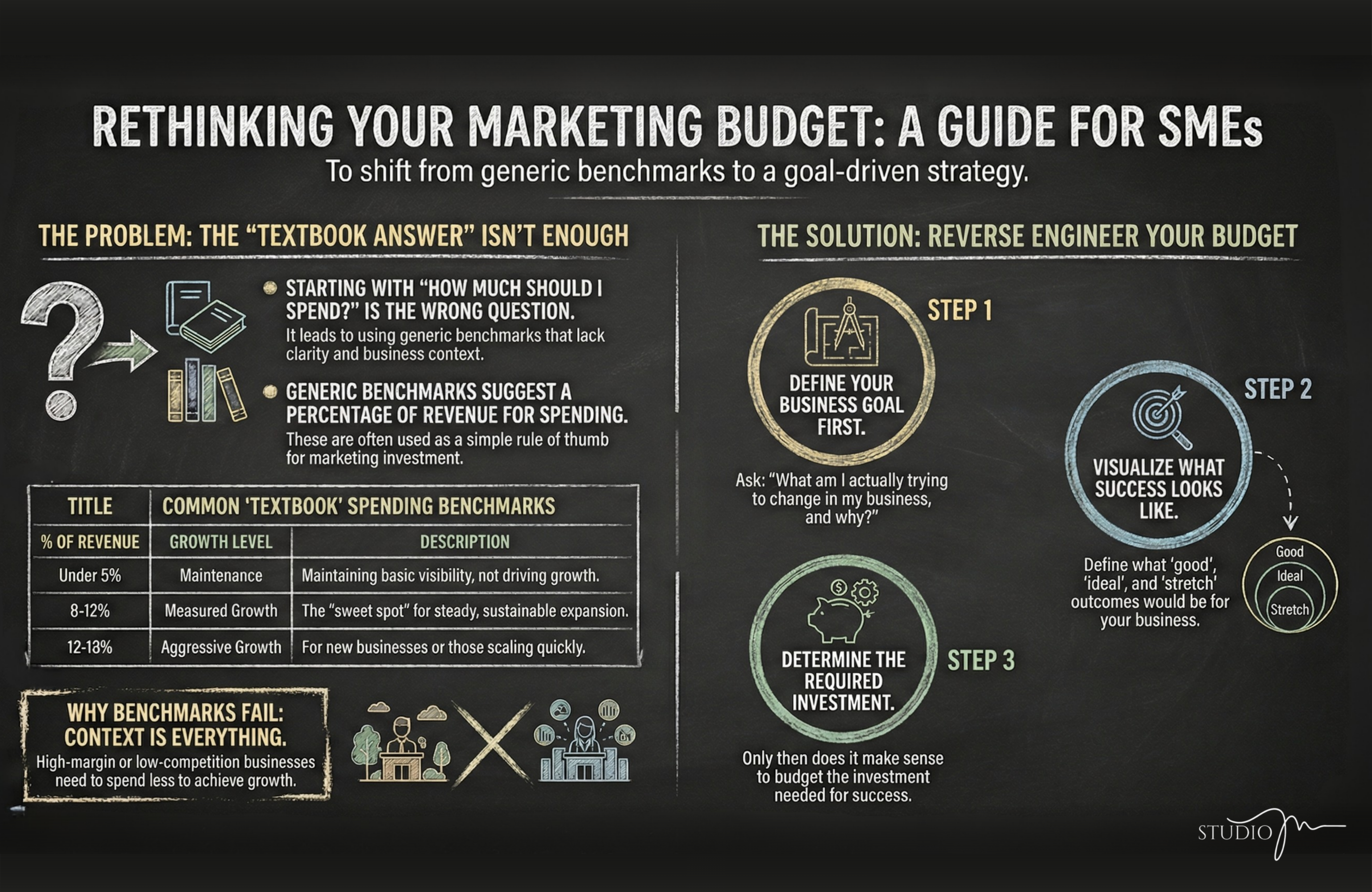
The short, textbook answer is: most SMEs spend somewhere between 5–12% of revenue on marketing.
But that number only becomes useful once you understand why you’re investing and what you expect to change in the business.
Without that context, even a “sensible” budget is a bit like buying tools before you’ve worked out what job you’re doing.
How much do SMEs typically spend on marketing?
If you are looking for a textbook answer to this question – here it is. Most conversations about marketing budgets use a percentage of revenue (not profit) as a rough guide.
Under 5% of revenue
Very conservative. Common when you’re fully booked or already at capacity. Marketing here is about maintaining a basic level of visibility, not driving growth.
5–8% of revenue
Your business is established and steady. You’re maintaining demand and credibility rather than trying to change the size of the business.
8–12% of revenue
Measured growth. In my view, this is often the sweet spot. It suits businesses that want to grow without putting too much strain on delivery or operations.
12–18% of revenue
Aggressive growth. More common for newer businesses or those deliberately trying to scale quickly.
That’s the textbook answer. Real-world decisions are rarely that neat.
Why the same percentage doesn’t mean the same thing for every business
In practice, those numbers only make sense in context.
Some businesses are, frankly, lucky.
Think high margins, low competition, strong inbound demand. A niche consultancy with a strong reputation. A specialist service with more referrals than it can handle. These businesses don’t need to throw 15% of revenue at marketing to grow – often they just need to tidy up how they show up.
Others operate in crowded, noisy markets.
Professional services, ecommerce, hospitality, consumer brands. In these cases, even staying visible costs real money. An 8–10% budget might not be “growth spend” at all – it’s simply the cost of showing up and not disappearing from view.
This is why copying benchmarks from other businesses, especially ones in completely different industries, tends to create confidence without actually improving decision-making.
The same percentage can represent wildly different levels of effort, risk, and return.
A better way to think about your marketing budget
Instead of asking “How much should I spend on marketing?”, a more useful question is:
What am I actually trying to change in the business, and why?
For example:
- Are you trying to fill unused capacity?
- Smooth out lumpy demand?
- Build a pipeline that gives you breathing room?
- Test whether a new market is viable?
Once that’s clear, the question of spend becomes much easier to answer. If you think you need “more sales,” but the real issue is that enquiries drop off every second month, the solution (and budget) looks very different than if demand is strong but conversion is weak.
Readiness matters more than people expect
Marketing rarely fails in isolation. What it tends to do is expose whatever already exists.
More attention puts pressure on systems very quickly. Sometimes that’s a sales process that isn’t quite there yet. Sometimes it’s pricing that doesn’t match the confidence you’re asking from customers. Sometimes it’s capacity, delivery, or simply the fact that the business isn’t set up to handle more conversations at once.
If you turn the volume up before the foundations are solid, marketing doesn’t fix the problem – it highlights it.
Using marketing as a way to learn, not just grow
One of the most underused roles of marketing is as a low-risk testing tool.
Before committing to a big launch, a major campaign, or a significant change, you can put a small version of an idea in front of the right audience and see how it responds.
That might look like:
- Testing demand for a new offer
- Checking whether a new market shows any interest at all
- Trialling messaging with a modest paid social budget before investing heavily in PR or production
The goal isn’t perfection.
It’s learning cheaply before committing properly.
Where most businesses go wrong
Most businesses decide on a marketing budget before they’ve defined what they expect marketing to change.
That number often comes from a percentage they’ve seen elsewhere. Sometimes it’s a rule of thumb. Sometimes it’s what feels reasonable. Occasionally it’s a “sweet spot” they’ve read about and decided to adopt.
The issue isn’t using a percentage as a guide.
It’s stopping there.
Without a clear line between why you’re investing and what needs to change, even a reasonable range becomes arbitrary. The same 8–12% can be either far too much or nowhere near enough, depending on the situation.
A more useful way to set a marketing budget
Usually, business owners aren’t confused about what’s not working.
They know where things feel tight. They know what’s creating pressure. They know whether growth feels stalled, inconsistent, or harder than it should be.
Where it gets harder is translating that into what marketing should actually be responsible for.
For example, two businesses might both say they “need growth”.
One is dealing with unpredictable enquiry levels that make planning difficult.
The other has steady demand, but keeps attracting work that isn’t quite right.
The underlying issue is different, even if the headline problem sounds the same.
This is where budgets tend to drift.
It’s common to settle on a number first, then expect the activity to sort itself out. It’s similar to committing to a new hire before being clear whether the real issue is capacity, skill set, or focus.
When the role marketing needs to play is well understood, the budget becomes easier to anchor.
It reflects the job marketing is being asked to do and how much weight it needs to carry.
That’s when marketing investment starts to feel proportionate and intentional.
Strategy sets the direction.
Budget follows.
FAQ
Yes, but only as a guideline. For B2B services businesses, spending 5–12% of revenue on marketing can be a useful sense-check, not a rule. The right level depends on margins, competition, sales cycles, and growth intent. The percentage helps frame the decision, but it doesn’t replace thinking about what the business actually needs to change.
No. Marketing spend shouldn’t rise automatically with revenue. When a business can’t comfortably handle more enquiries, defend its pricing, or convert interest efficiently, marketing’s role often shifts. Instead of driving more demand, it may be better used to maintain visibility, strengthen brand, support retention, or prepare the business for its next phase of growth.
Not necessarily. If your business is already at capacity, marketing isn’t a growth lever.
In this situation, marketing is better used to stabilise demand, protect pricing, and improve enquiry quality rather than increase volume. Spending more to drive growth before delivery is ready often creates operational stress – this is why the right strategy is critical.
In most cases, consistent marketing spend works better than short bursts.
Consistency allows learning, adjustment, and compounding over time, which matters particularly with longer decision cycles. Bursts can be useful for testing or launches, but sporadic spending driven by impatience often produces misleading results.
Early signals often appear within weeks, but meaningful impact takes months.
The timeline depends on your objectives and strategy. Early signs might be better conversations or clearer positioning, with commercial results following later. Expecting immediate returns often causes businesses to stop just as momentum builds.