

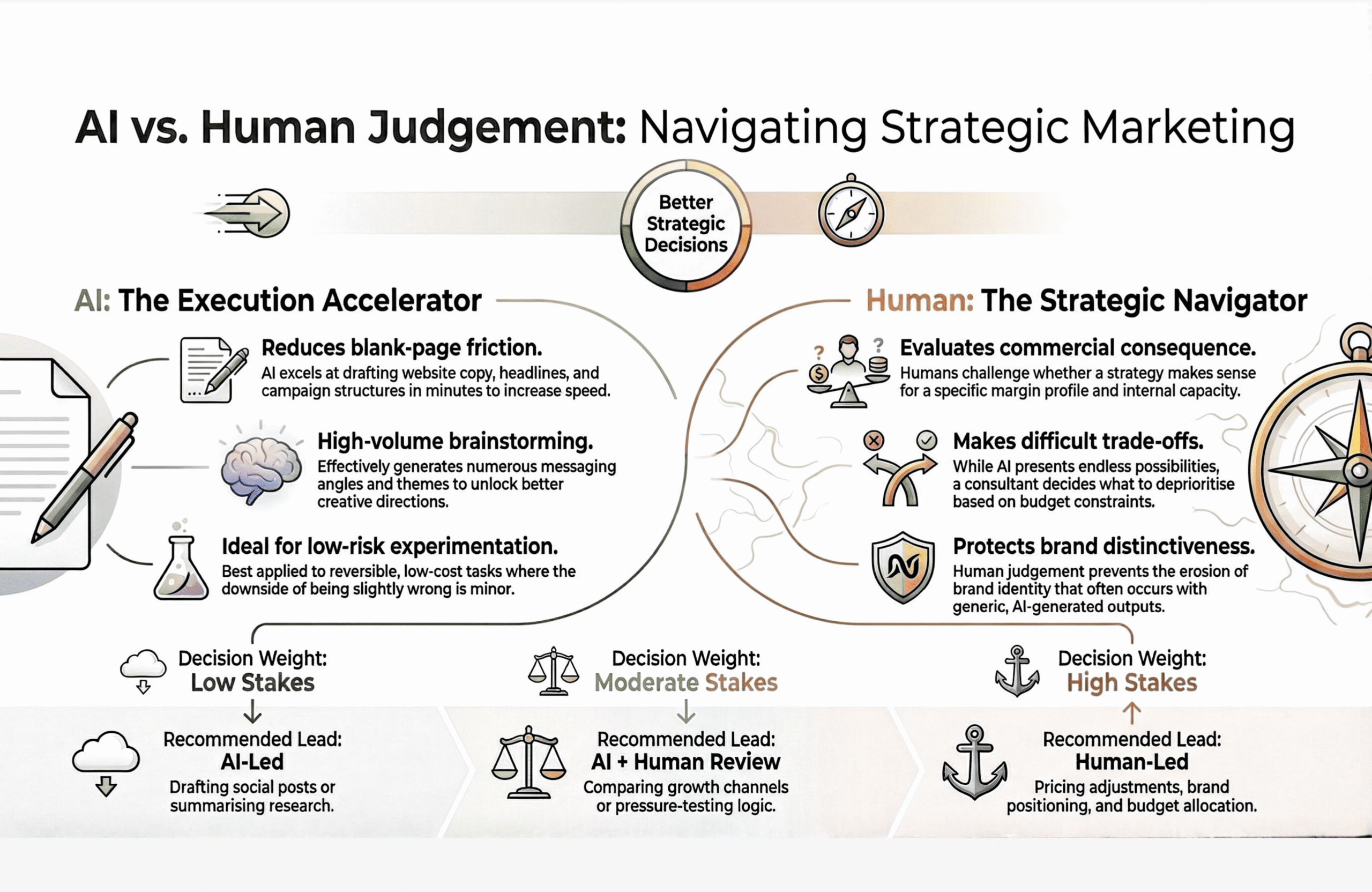
AI has made marketing capability dramatically more accessible. Businesses can now generate campaign plans, draft website copy and explore growth channels in minutes.
So the question is reasonable: if AI can do the work, should you still hire a marketer?
When marketing is reduced to execution, it’s easier to assume AI can replace it.
But marketing at a meaningful level is not just execution. It is deciding where to focus, understanding the commercial implications of those decisions, and protecting the distinctiveness of a brand that generic output can quietly erode.
In short: AI can replace many marketing tasks, but it cannot replace an experienced, commercially aware marketing consultant. AI is effective for drafting content, research, idea generation and early-stage experimentation. What it does not independently do is evaluate commercial risk, challenge assumptions or prioritise based on lived exposure to what tends to succeed or fail in real businesses. For lower-risk experimentation, AI is often sufficient. For higher-stakes decisions involving budget, positioning or growth direction, informed judgement materially reduces the likelihood of costly mistakes.
What Gets Lost When No One Challenges the Plan?
If marketing were purely about producing assets, AI would already have replaced a large portion of external support. It can write competently, structure ideas clearly and process information quickly.
The difference shows up in evaluation.
AI works within the logic it is given. If a business asks whether it should invest in LinkedIn, Google Ads and Reddit, it will usually construct a rational case for each. It will explain audience targeting, campaign mechanics and potential reach. The answer will sound structured and balanced.
What it will not instinctively do is step back and ask whether those channels make commercial sense for this specific business, in this specific market, with this specific margin profile and internal capacity. It responds to the frame. It does not naturally question whether the frame is wrong.
That distinction is subtle but important. A strategy can be coherent and still misaligned.
What AI Is Good At, and Where It Falls Short
AI is strongest when the downside of being slightly wrong is small. Drafting content, exploring messaging angles, synthesising research, outlining campaign structures before committing spend. In these contexts, it reduces friction and increases speed without materially increasing risk.
Where it becomes less reliable is in situations that require judgement under constraint.
Real businesses do not operate in ideal conditions. They have budget ceilings, internal politics, delivery limitations, founder fatigue, brand history and market reputation to consider. Strategy in that environment is less about what could work in theory and more about what will work here.
This is where a human operator adds value beyond “experience” in the abstract.
An experienced marketer reframes problems. When a business asks for more leads, they may look first at close rate, offer-market fit or pricing before recommending additional traffic. They filter signal from noise, distinguishing between trends that are structurally relevant and those that are simply visible. They sequence decisions, recognising that increasing acquisition before tightening conversion often amplifies inefficiency rather than revenue.
They also narrow options. AI presents possibilities. A consultant makes trade-offs. Given a fixed budget and a defined growth target, they will say what to deprioritise as much as what to pursue.
That narrowing is not about being smarter. It is about being accountable to consequence.
When Should You Hire a Marketing Consultant Instead?
No marketer gets every decision right. Markets shift, platforms evolve and external variables cannot be controlled. The value of experienced judgement is not certainty. It is risk reduction.
External expertise becomes disproportionately useful when decisions carry meaningful weight. Increasing paid acquisition spend. Repositioning the business. Adjusting pricing. Expanding into new channels. In these moments, the cost of misjudgement compounds quickly, both financially and in lost time.
There is also a developmental angle worth acknowledging. AI can inadvertently compress the learning curve for entry-level marketers. The work may look polished because the structure is supplied instantly. What is harder to accelerate is the slow development of commercial intuition that comes from testing, failing and interpreting outcomes over time. Without that foundation, it becomes difficult to critically evaluate the outputs being generated.
So the more useful question is not whether AI can produce a marketing plan. It can. The question is whether the business has the internal capability to rigorously challenge that plan before committing time and budget to it.
If the downside of being wrong is minor and reversible, AI-led experimentation is commercially sensible. If the downside affects revenue trajectory, positioning or long-term growth direction, informed external judgement becomes far more valuable.
AI is a powerful tool. In capable hands, it accelerates progress. Without critical evaluation, it accelerates momentum in whichever direction it is pointed.
The decision is not ideological. It is commercial. What is at stake, and who is best placed to see the blind spots before they become expensive?
Not sure where to start? Get in touch.
FAQ
AI is most useful in marketing when it speeds up production without pretending to replace judgement. It can help draft content, generate variations, summarise research and organise ideas quickly.
Where it tends to fall short is in nuance. It does not understand your brand the way you do. Without clear guardrails, it defaults to generic language and widely accepted “best practice”. Used properly, it accelerates thinking. Used passively, it produces output that sounds polished but indistinct.
The value is not in letting AI decide what to say. It is in using it to refine and pressure-test what you already believe.
AI saves the most time in early-stage thinking and production. It is particularly effective for brainstorming. It can generate angles, headline variations, campaign themes and positioning directions far faster than most teams can internally. Even if half of the ideas are average, it often surfaces one or two that unlock a better direction.
It also reduces blank-page friction. Drafting first versions of content, organising messy notes into structure, or condensing large volumes of research into something usable are all areas where AI meaningfully speeds things up.
Data analysis is more nuanced. If you upload campaign results without context, AI will typically return high-level observations that lack commercial depth. It may highlight trends, but it does not understand what you were trying to achieve or what constraints shaped the campaign. Insight improves significantly when you provide your hypothesis, objectives and next-step thinking. At that point, AI becomes a sounding board rather than an analyst.
In short, AI is strongest when generating options and structuring information. It is weaker when interpreting consequences.
You don’t need a complex AI stack to get value. The highest return usually comes from improving decision quality, not adding more tools.
Use AI to pressure-test your thinking before increasing spend or expanding into new channels. Ask it to challenge your assumptions, outline risks, and model best- and worst-case scenarios. Not to decide for you, but to expose gaps in your logic.
AI is also effective for comparing strategic options. If you’re weighing two growth directions, use it to surface trade-offs and unintended consequences before committing a budget.
Where businesses waste money is using AI to justify doing more. The smarter use is the opposite. Use it to strengthen and interrogate what already exists before adding complexity.
AI has already raised the baseline of marketing execution. The next shift is more interesting. As businesses begin training AI on their own data, historical decisions and internal frameworks, these tools will increasingly replicate consistent judgement, not just produce content.
In practical terms, that means parts of strategic thinking can become systemised. If you repeatedly make decisions based on margin thresholds, positioning principles or budget constraints, an AI trained properly can start applying those same filters at scale.
For business owners, this creates leverage. Routine decisions become faster. Internal consistency improves. Fewer hours are spent re-evaluating the same trade-offs.
Where human judgement still matters is at the edges. When markets shift. When assumptions break. When a new constraint appears. AI can extend existing thinking extremely well. It cannot independently sense when the underlying model itself needs to change.
The future is not AI replacing judgement entirely. It is AI institutionalising the judgement you have already developed, while humans remain responsible for evolving it.
AI is most effective when applied to structured, repeatable thinking. It works well for generating options, testing messaging angles, modelling scenarios, summarising research and pressure-testing plans before budget is committed. In these areas, it increases speed and consistency without materially increasing risk.
Where AI should not operate independently is in decisions that alter direction rather than refine execution. Budget allocation, pricing changes, positioning shifts and major channel expansion carry consequences beyond performance metrics. These choices involve trade-offs across margin, reputation, operational capacity and long-term growth.
A practical filter is this:
If the decision is reversible and low-cost, AI can play a larger role.
If the decision shapes trajectory and would be expensive to unwind, human judgement should remain accountable.
AI can extend thinking and institutionalise patterns. It should not quietly become the final authority on where a business or brand is heading.
A common rule of thumb suggests 5–12% of revenue for many small to mid-sized businesses. That figure can be directionally useful, but only in context.
The more important question is what that investment is expected to change. Growth stage, margin profile, sales cycle and competitive pressure all affect what makes sense. Without that clarity, even a sensible-looking budget can be misallocated.
If you want a deeper breakdown of how to think about marketing investment, I’ve written about it in more detail here:
How Much Should I Spend on Marketing?